
At a Glance
You can’t help someone win if you can’t see what they’re holding.
Cards on the Table is a coaching tool born at a card table and applied to a professional world full of guessing. Most leaders and teams operate on incomplete information because showing your hand feels risky. The tool names the two cards people are most afraid to play and gives four questions for putting them on the table, so the real conversation can start.
Teaching my daughter euchre
My younger daughter was learning euchre. If you haven’t played it, euchre is the card game the Midwest runs on: a small deck, fast hands, and a lot of reading the table. It’s the kind of game where how you play matters almost as much as what you hold. (Trust me on this. I’ve watched my mom, my uncle, and my grandma all beat me with what seemed like nothing in their hand. They were merciless.)
When you’re teaching someone, there’s a moment where you flip your cards face-up. You lay them on the table and walk through the hand together. “Here’s what I’ve got. Here’s what I’d lead with. Here’s what I’m saving. Here’s the risk.”
The point of that hand is learning to see what you’re holding and how to think about it. Whether you win it barely matters.
Not everybody teaches their kids this way. Some people deal the cards and let you lose until you figure it out. That’s less fun for me. I’d rather teach people how to win, and then we’re having a lot more fun together.
Later that week I was in a coaching conversation, and the leader across the table was doing the same thing I’d watched my daughter do: staring at the hand, unsure which card to lead with, afraid to show what she was holding. And it hit me that I see this every week. Leaders walk into a conversation holding a hand of cards they didn’t choose, facing a table they can’t fully read, and they keep playing the same card because it’s the one they know.
You can’t help someone win if you can’t see what they’re holding.
The professional guessing game
A manager knows an employee is drifting but keeps the feedback soft because the relationship feels fragile. That’s the manager holding a losing card: “I see a gap, and I’m not naming it.” Meanwhile the employee knows exactly what would help them stay and won’t say it, because it might sound demanding. That’s the employee holding a winning card: “I know what I need, and I won’t ask for it.”
Both people are at the same table. Both care about the outcome. And neither one can see what the other is holding.
What sits between them is partial information. Left long enough, partial information starts to feel like the whole story.
The bold card and the vulnerable card
In my coaching work, the cards people hold back tend to fall into two categories. I call them the bold card and the vulnerable card.
The bold card is the one you know would help you win. The thing you want, the move you’d make, the request you’d put forward if you weren’t worried about how it would land. A role change. A resource. A conversation you need to have. You know it would move things forward. You won’t play it because it feels like too much.
The vulnerable card is the one you’re afraid will give away your loss. The thing you’re struggling with, the gap you see in yourself, the mistake you made, the doubt you’re carrying. You hide it because you think showing it will cost you credibility. Hiding it usually costs more, because the people around you can sense something is off, can’t name it, and the distance grows.
Both cards stay hidden for the same reason: trust isn’t high enough to play them. And playing them is exactly what builds the trust.
When we use this tool in a coaching conversation, it comes down to four questions:
- What cards are you holding?
- What cards might you be afraid to show?
- What seems like a win to you in this situation?
- What can we do together to win?
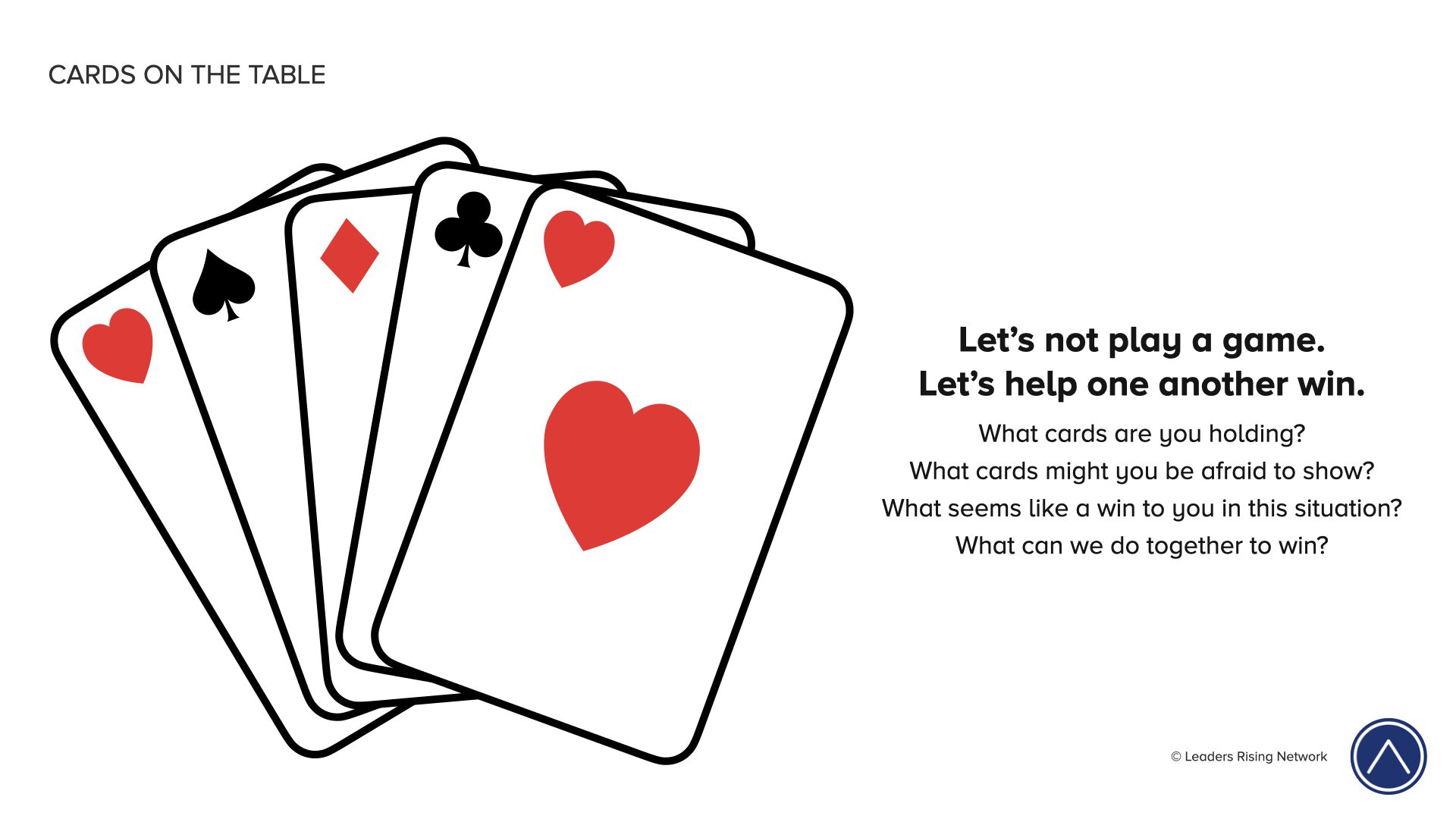
The first two surface the hand. The second two change the game. Most people have never been asked what winning looks like to them, and “what can we do together to win” is the question that moves a conversation from guessing to partnership.
What the data says
30%
of employees strongly agree their manager involves them in setting their goals. Those who are involved are 3.6 times more likely to be engaged.
Source: Gallup, “Re-Engineering Performance Management”
What happens when someone puts their cards down
I coached a leader a while back who had just stepped into a new role. She was smart, capable, and cared about her people. She was also holding her cards close. Playing it safe. Showing competence without showing herself.
We started using these four questions in our coaching conversations. I asked her to name the card she was afraid to show. It took a while. Weeks, actually. The first few times she named surface-level things. Safe cards, the kind you play when you’re not ready to show the real hand.
Eventually she named the vulnerable card: she wasn’t sure she was the right person for the role, and she was compensating by over-performing on every visible metric while avoiding the conversations that mattered most.
It didn’t go smoothly at first. Her boss heard “I’m not sure I’m the right person” as a confidence problem. She meant it as a bid for honesty. We had to coach through that too, helping her boss see that a person can name a doubt and still be the right person for the job. That took another conversation, and a harder one.
Once both of them could see the real hand, things shifted. Her boss, who had been reading her distance as disinterest, started seeing her more clearly. She earned more credibility from those two honest conversations than from six months of proving herself.
I can think of three leaders I’ve shown this tool to as they stepped into a new role, one of them a brand-new VP. A new role is when the pull to keep your cards close is strongest, and it’s when opening them up helps the most.
Every one of them who put their cards down in a relationship they trusted found it went much better than they’d imagined.
I can’t promise it always goes that way. Some people will play the game against you, and that’s a different conversation (more on that below). With someone you trust, though, the relationship gets real, and that’s where the work happens.
Key Takeaway
You can’t help someone win if you can’t see what they’re holding. The two cards people hide most: the bold card (the move they know would help) and the vulnerable card (the struggle they think will cost them).
“But what if they use it against me?”
I hear this every time I teach the tool, and it does happen. I’ve shown my cards and had them used against me. Early in my career, it cost me a job.
What I took from that: those aren’t people I want to play a game with. I’m choosing something better. I’m willing to show you my cards, and if you’ll show me yours, I can help you win too.
Can you get taken advantage of? Yes. Does it cost you something? Sometimes. Then you get to move to the next table, and the next table is where the people are who want to win together.
There’s a harder version, and it’s the one that stops most leaders from trying: the silence. You show your hand and get nothing back. The other person doesn’t reciprocate. You went first, and you’re standing there alone.
That happens more often than the betrayal version, and it’s what makes leaders stop going first.
From my perspective, someone who isn’t showing their cards yet may need more time. Some people need to watch you go first more than once before they believe it’s safe. The first time you show your hand and get silence, count it as a deposit on something that doesn’t pay out on the first hand.
Sometimes, though, someone holds cards back because they’re playing against you. They’re managing information and protecting position, keeping their hand hidden because they think their advantage depends on your disadvantage. Treat that as a signal. When someone consistently plays cards against you, the conversation shifts from “let me help you show your hand” to “we need to decide if we’re playing the same game.”
This is all about the long game. Let’s not play a game. Let’s help one another win.
The long game
We use this tool in every kind of conversation, and over time it becomes a way of being in professional relationships.
Every coaching conversation, every one-on-one, every hard meeting: what cards are on the table, and what’s still being held back? Which card are you holding right now, the bold one or the vulnerable one? And what would it cost you to play it this week?
You can’t help someone win if you can’t see what they’re holding. And they can’t see yours if you won’t go first.
I’d rather help people win.
If you want to build the kind of team where people stop guessing and start being honest about what they’re working with, that’s the conversation we help leaders have every day, and we’d be glad to have it with you.
Let’s talk
Sometimes it starts with coffee.
Just a real conversation about where you are and where you want to go. We’ll listen first and bring you our best. We’d love to meet you.


