
Three levels of culture every leader misreads
Most culture work happens at the surface: the values poster, the handbook, the rollout. Culture itself gets built somewhere smaller, in the moments no one planned for.


Jeff Lovell is a senior leadership advisor and President of Leaders Rising Network, where he partners with executive teams to align culture with strategy and build healthy leadership pipelines. Known for his clarity and grounded presence, Jeff helps leaders grow in self-awareness, make better decisions under pressure, and build cultures that support both performance and people. Jeff and his wife live in Madison, Wisconsin, and are grateful for this season with their adult daughters. Outside of his work with leaders, he values unhurried mornings with coffee, long walks on Wisconsin trails, and conversations that go beneath the surface.
Most culture work happens at the surface: the values poster, the handbook, the rollout. Culture itself gets built somewhere smaller, in the moments no one planned for.

Most leadership tensions show up as either/or, and most of us pick a side and call it a style. The best leaders know which dial to turn, and when.

Most organizations vet a leadership partner on credentials. The questions that actually predict whether the work sticks are about something else: what happens after they leave.

Most leaders who are the bottleneck already know how to delegate. They don’t, because being the one everything runs through gives them something they’re not ready to give up.
We think trust is built in the big moments: the offsite, the vulnerable speech, the crisis handled well. It is built in the small rhythms we are most tempted to cancel.

We grade ourselves on our intentions. Everyone we lead grades us on our impact. The gap between the two is where trust is won or lost, and most leaders never see it.

When trust runs on policy alone, managers manage process. How National Exchange Bank traded compliance habits for a shared leadership language, and made it stick.

Two operators, eight feet apart, and a question nobody logged. Why the team dynamics that never show up on a process map are slowing your process down, and the flywheel that fixes it.

A VP with the vision, the credentials, and the results still felt like he was leading from an island. What he was missing was influence, and influence is built on four ingredients of trust.
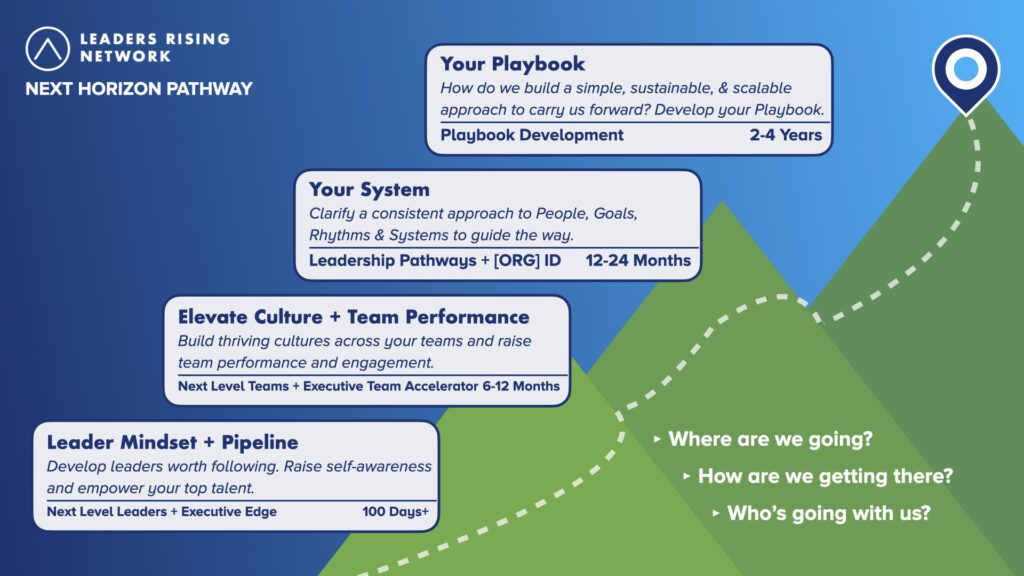
Your first 100 days and a long-term plan to transform culture. The Next Horizon Pathway, in plain terms: where you are going, how you get there, and who goes with you.
Stay in the loop. Practical leadership and culture ideas, in your inbox now and then.