
Executive Summary
Team dynamics are process inputs.
Most improvement efforts push alignment and execution, and every push costs more than the last. Teams that build a common language and trust first turn a flywheel that improves every process at once and builds lasting capacity.
Two operators work the same line. Eight feet apart, ten hours a day, five days a week. Last Tuesday, one of them got new gloves. The other one noticed.
Nobody logged it. No metric caught it. But for three weeks now, one station has been running a half-step slow, and the operator running it couldn’t tell you why if you asked. He’s not sabotaging anything. He’s just carrying a question around all shift: why does that guy get new gloves and I don’t?
If you’ve spent any time on a production floor, you know this isn’t the only question being carried around. Why does he talk so much when I just want to get my work done? Why does she get along with everyone while I can’t get a straight answer from my own shift lead? Why do the day shift and night shift act like rival companies?
None of these questions appear on a process map. All of them slow the process down.
The objection we hear in every plant
Manufacturing leaders are some of the best process thinkers we work with. They can tell you takt time, changeover time, scrap rate, and first-pass yield from memory. They’ve run kaizen events and value-stream maps. They believe, correctly, that what gets measured gets managed.
So when someone like us shows up talking about communication and trust, we know exactly what they’re thinking. This is the soft stuff. Nice to have. We’ll get to it after we hit our numbers.
We’d push on one word in that sentence: after. The questions those two operators are carrying around are already inside your numbers. Team dynamics are process inputs, the same as material quality and machine uptime. They’re just the inputs nobody is measuring.
Investing in your people is a process improvement. That’s the whole argument of this article, and we’re going to make it with a tool.
Investing in your people is a process improvement.
The flywheel and the pendulum

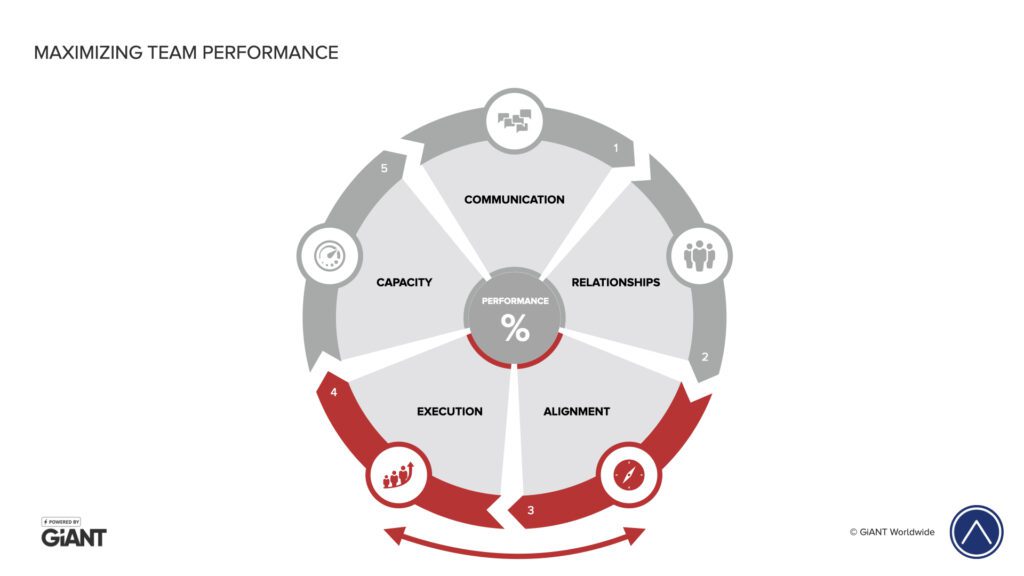
We use a framework called Maximizing Team Performance, built on research into what high-performing teams across industries have in common. Five components surround performance at the center: communication, relationships, alignment, execution, and capacity, in that order.
The order matters more than anything else about the tool.
Most organizations, especially process-driven ones, enter at stages three and four. Alignment: get everyone pointed at the same goals. Execution: hold everyone accountable for hitting them. More meetings, clearer metrics, tighter follow-up. And it works. Output climbs for a quarter, maybe two.
Then it needs another push. So leadership pushes again. New scorecard, new accountability cadence, new all-hands about priorities. Output climbs again, a little less this time. Then it needs another push.
That’s a pendulum, swinging between alignment and execution. A pendulum only moves when you push it, and every swing costs more energy than the last. The leaders doing the pushing feel it first. The exhaustion you might be feeling as you read this is the cost of running a team on pushes.
Now back up two steps on the tool.
Communication, in this framework, means a common language, and that’s a different thing from more meetings. It means your team shares words for how each person thinks, decides, and contributes, so the talker and the head-down worker stop reading each other as problems and start reading each other accurately.
Relationships means trust. Again, a different thing from friendship or forced fun. Trust is what lets an operator ask “hey, how’d you get new gloves?” instead of carrying the question for three weeks. Trust is the difference between a question asked in ten seconds and a resentment compounding daily.
When a team builds those two first, watch what happens to the other three. Alignment stops being something leadership pushes and starts being something the team produces, because people who understand each other and trust each other align quickly and stay aligned. Execution speeds up, because nobody is quietly working around, or against, the person eight feet away. And the loop starts feeding itself: better execution builds more trust, more trust speeds up communication, and the whole system gains energy with each turn instead of losing it.
That’s a flywheel. It feels heavier to start, then nearly effortless to keep turning. And what the flywheel produces, over time, is the fifth component: capacity. A line that can absorb a rush order, a new hire, or a breakdown without the whole system wobbling. Capacity is what every operations leader actually wants, and you can’t push your way there. You build your way there, starting two steps earlier than most improvement efforts start.
Investing in your people is a process improvement. Arguably the highest-yield one available to you, because it improves every process at once.
Key Takeaway
A pendulum only moves when you push it. A flywheel gains energy with every turn.
Back to the gloves
Underneath the glove question sits the real one: does anybody see me?

A supervisor with a common language and real trust on the floor handles that moment in ninety seconds. He notices the friction, asks about it, explains that the glove order rotates by station, and the question is gone. The half-step slowdown is gone with it.
A supervisor without those things never hears about the gloves at all. The resentment just sits there, quietly taxing one station’s output for a month, and no kaizen event in the world will find it, because the root cause isn’t in the process. It’s in the people running it. And people dynamics, left unhealthy, will eat any process improvement you lay on top of them.
This is why we tell process-minded leaders that this work belongs in the same category as preventive maintenance. You already accept that machines need scheduled attention before they break, and that running them to failure is the expensive option. Your teams work the same way. Communication and trust are the scheduled maintenance. The pendulum-push cycle of alignment and execution alone is running the team to failure.
What this looks like in practice
Starting requires what every flywheel requires: a first turn.
Give your team a common language. We start most engagements with the 5 Voices, a fifteen-minute assessment that gives every person on the team, from the C-suite to the line, shared words for how they communicate and what they need to do their best work. It’s the fastest way we know to turn “why does he talk so much” into “he’s a Connector, that’s where his energy comes from, and here’s what he’s actually good at.”
Then build trust the way you’d build anything else: deliberately, with structure, on a schedule. Small groups. Real conversations about what it’s like to work next to each other. The same rigor you’d bring to any other input that drives output, because that’s exactly what this is.
Measure what changes. Engagement, turnover, near-miss reporting, cross-shift handoff quality. The numbers move, because the inputs moved.
Investing in your people is a process improvement. The organizations that treat it that way stop pushing the pendulum and start turning the flywheel, and the ones we’ve watched do it would tell you the process itself got better, because the people running it stopped working against each other and learned how to bring out the best in each other.
What question is somebody on your line carrying around right now?
Discover your leadership Voice.
In 15 free minutes, see how you naturally lead and how others actually experience you.


