At a Glance
The best leaders know which dial to turn, and when.
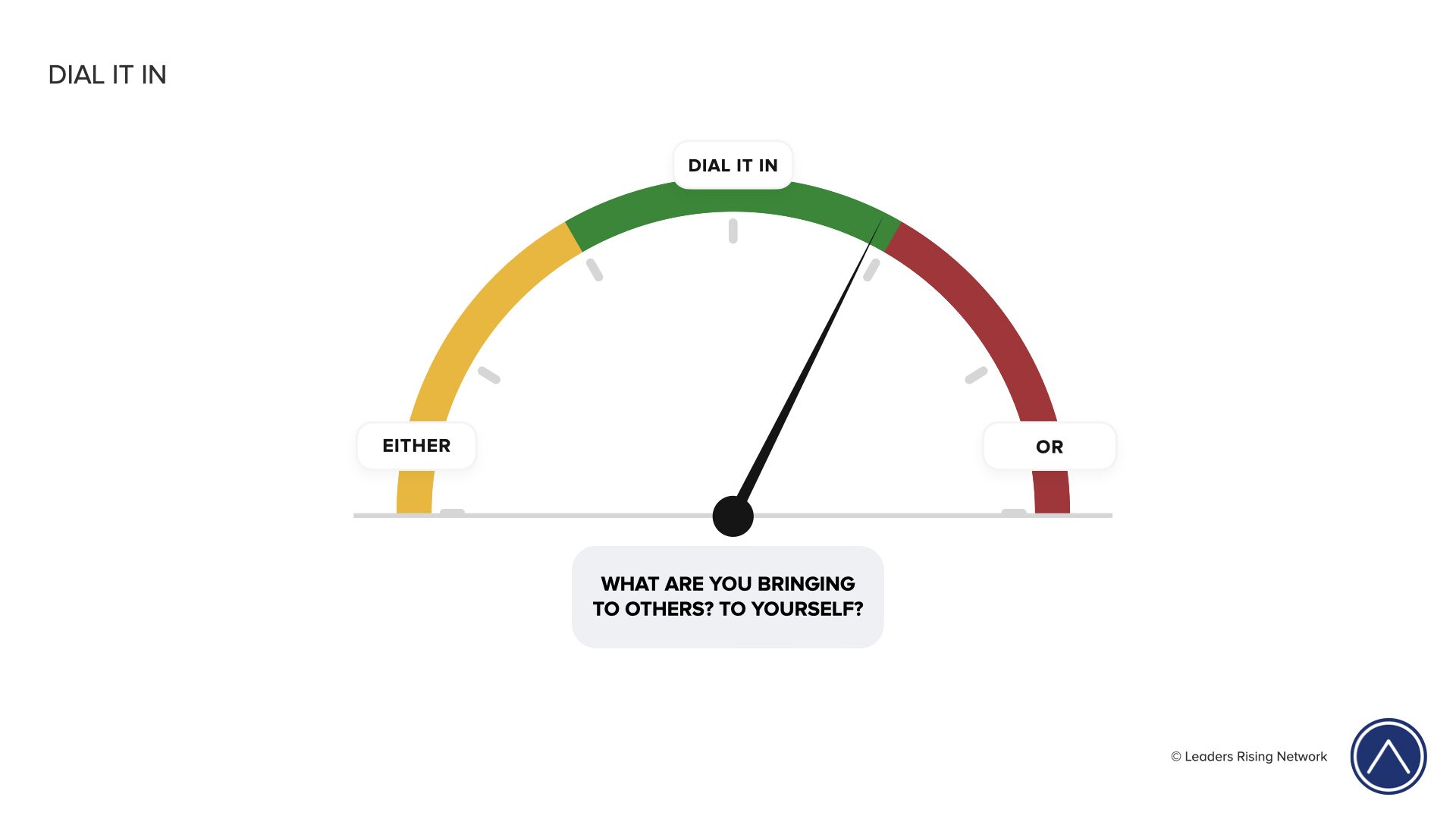
Leadership is full of either/or questions, and most of us have a side we default to. The better answer is to dial it in. Dial It In helps leaders see where their needle usually rests and choose the setting the moment needs, starting with one question: what am I bringing to others, and to myself? There’s usually more than one dial in play, and seeing the others gives us more room to move than we thought we had.
My default is the future
I’m a Creative. Put a whiteboard in front of me, ask where a team could be in three years, and I’m happy for the rest of the afternoon. Ideas show up half-formed and I love every one of them (even if I can’t remember them tomorrow).
That wiring is a gift most days. It’s also the reason I can walk right past the thing that’s broken this week on my way to the thing I’m excited about next year. And I have a hard time saying no, which I’d like to call generosity. Some days it is. Some days it’s a default I haven’t looked at.
Every leader has a version of this: a strength that works so often we stop noticing we’re choosing it.
The best leaders know which dial to turn, and when.
When a strength goes too far
Every leader has natural strengths. Maybe she’s encouraging. Maybe he’s direct. Maybe they process out loud, or sit with something for a day before they say a word. Whatever they are, they work. People respond to them, and over time they become the leader’s identity.
Then the situation changes, but the strength stays the same. The dial doesn’t move.
The encourager who hasn’t delivered hard feedback in a year. The direct leader who bruises someone in a moment that called for patience. The external processor who fills every silence and wonders why the quiet voices on the team stopped talking. The future thinker (I’m raising my hand) who can describe the vision beautifully and may not clearly see what’s broken right now.
Every one of those leaders is playing a real strength, past the point where it helps. Each of us has a resting place for the needle, and most of us don’t know where it is.
Between either and or
Most tensions in leadership show up as either/or. Do we push for results, or take care of our people? Speak up now, or wait? Hold the line, or make the exception? The question seems to have two answers, so we pick one.
The better answer is to dial it in.
Each end has something true in it. Live at one end long enough, though, and what we’re protecting starts to cost us. All care and no push lets people off the hook. All push and no care burns through good people.
Dialing it in means finding the setting this moment needs. The same leader with the same team might lean one way on Monday and the other way on Thursday. The discipline is knowing where the needle sits right now and moving it on purpose, instead of parking at one end and calling it a leadership style.
At the center of the tool is one question, and we come back to it in every coaching conversation:
What are you bringing to others? What are you bringing to yourself?
Where do you need to dial it in?
“This is how I am”
Every time we teach this tool, someone pushes back. It usually sounds like, “I’m direct. That’s how I’m wired.” Or, “I’m a people person. I’m not going to turn into a drill sergeant.”
I get it. My wiring pulls me toward new possibilities every time.
“This is how I am” is a fair place to start. Knowing how we’re wired matters, and it’s where the 5 Voices work begins. It can’t be where we stop, because the people on our teams live with the setting we choose every day.
What the data says
70%
of the variance in employee engagement scores across business units comes down to the manager.
Source: Gallup, “Managers Account for 70% of Variance in Employee Engagement” (2015)
That’s a lot riding on the setting we choose.
Healthy, mature leaders know how they’re wired, and they dial it in anyway. They start from their natural setting and ask what they’re bringing to others, and to themselves.
More than one dial
Once we get comfortable with one dial, a second thing shows up: most leaders walk into a hard decision thinking there’s only one to turn. Yes or no. Keep the deadline or move it.
There’s almost always more than one dial on the table.
A compensation conversation has salary on it, and it also has hours, benefits, title, responsibilities, and room to grow. A product decision has features on it, along with cost, timeline, and whatever the customer was promised last spring.
When someone feels stuck between two options, they’re usually staring at a single dial. Name the other dials and the room changes. People see how much more they can move than they thought, and we get to turn the dials together.
No leader is expected to know by magic where every dial belongs. Often the most useful move is naming the dials with the people we lead. We don’t always know what matters most to someone else, and naming the dials together gives us a way to find out.
Key Takeaway
The best leaders know which dial to turn, and when. Before deciding you’re stuck, look for the second and third dial.
This is my favorite part of the tool. The leader who walked in trapped between two bad options walks out with three or four moves they hadn’t considered.
Tensions to manage
We reach for Dial It In most often when someone feels stuck. A leader caught between a struggling employee and a team that’s carrying the extra load. A manager who wants to be transparent and isn’t sure how much to share yet.
Those are tensions to manage, and they stay open longer than any of us would like. The work is holding two true things at once without letting the situation collapse into the simple answer, because the simple answer is always easier to defend in the next meeting.
The leaders who do this well still miss the calibration sometimes. What they have is a habit. Before they act, they ask: where am I defaulting, and what does this moment need from me?
I’m still learning to ask it before I suggest a new change.
The best leaders know which dial to turn, and when.
This is the conversation we help leaders have all the time, and we’d be glad to have it with you.
Let’s talk
Sometimes it starts with coffee.
Just a real conversation about where you are and where you want to go. We’ll listen first and bring you our best. We’d love to meet you.