Executive Summary
Most companies ask their CFO to fund leadership development without a number behind it, then watch the spend get deferred.
The fix is to price the cost of doing nothing: meeting drag, decision drag, and capacity drag, calculated against your own salaries, your own calendar, and your own senior team. Once that number is on the table, the question stops being “is leadership development worth it?” and becomes “which is the bigger spend, the program or the alternative?”
Leadership development often feels like a leap of faith. You know it matters, but when budget season rolls around, your CFO wants proof. Not theory. Proof you can defend on a slide.
Most companies ask their CFOs to fund leadership development without a number behind it. HR brings a proposal the CEO supports. The dollar figure looks reasonable. Then the CFO asks the question every CFO asks.
"What's the return?"
The HR team’s answer points at long-term retention and behavior change. The CFO is looking for a number he can defend in this quarter’s budget review. When the answer does not match the question, the spend gets deferred to next quarter, to next year, to the year nobody talks about anymore.
Here is what is actually happening in that conversation. The HR team is trying to prove the ROI of a system. The CFO is trying to underwrite a number. Two different questions, sitting on either side of the same conference table. The gap between them is where most leadership development budgets get cut.
You can fix this. The fix is showing the CFO a number he is already paying. He just has not seen it on a slide or spreadsheet.

The Number Nobody Is Showing the CFO
Most leadership development ROI conversations start with the development side of the equation: hours of training, cohort size, behavior change targets, retention math, productivity lift. All of it stacks up on a slide and the CFO listens politely.
That is incomplete. It is the cost of the program without the cost of the alternative. The CFO needs both.
The number nobody is showing him is the cost of doing nothing. The cost of inaction. The cost of staying stuck on the same problems quarter after quarter while the proposal sits unfunded.
"How much will it cost if you do nothing?"
The CFO does not believe leadership development is free. He also does not believe the alternative to leadership development is free. He needs both numbers, side by side, before any investment decision can be priced.
You cannot fix what you have not priced. That is the rule. And the cost of doing nothing, the cost most companies are paying without naming it, is what almost nobody is pricing.
Three Places the Cost of Inaction Is Hiding
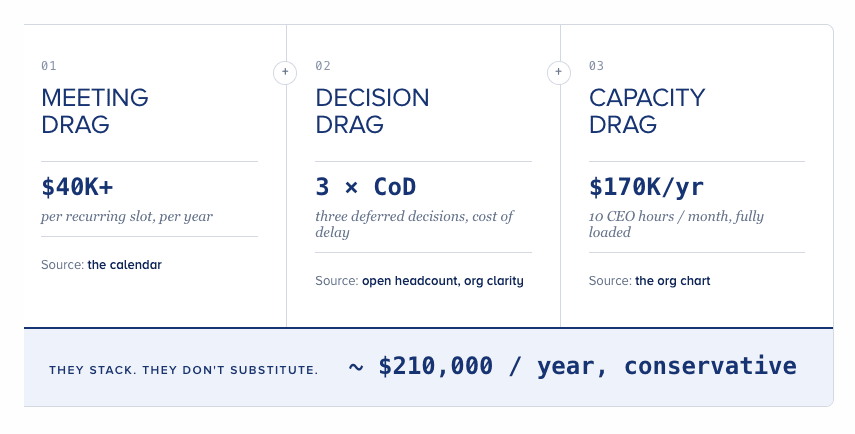
The cost of doing nothing shows up in three categories. Each one has a number behind it. The math is not complicated. It is just that nobody runs it.
Where the cost of inaction hides
-
1
Meeting drag. Pull a recurring leadership meeting on your calendar. Two hours, eight people, $100,000 average salary. That meeting costs the company $800 in raw salary every time it runs. Run it once a week and you are spending $40,000 a year on that one recurring slot. Run meetings every day, and the cost starts stacking. The dollar cost is the floor. What matters is what comes out of it. If the team walks out without a decision, that is the full annual figure producing nothing. If the team walks out with a half decision they will revisit next month, that is the full annual figure producing momentum loss. The cost of the meeting is just the floor. The cost of the meeting not working is the real number.
-
2
Decision drag. Every senior leader on your team is carrying a decision they have not made. The org chart shift they keep deferring. The hire they are dragging on. The conversation they are avoiding. Each of those carries a real cost that compounds week over week. You do not have to measure every decision. Pick three and price them. The hire that is six months overdue and is still costing the company the salary you would have paid plus the productivity gap of the missing role. The reorg that has been on the whiteboard since Q1 and is costing the company every quarter of scattered execution underneath it. The conversation nobody is willing to have, costing the company the trust gap inside the team. For most senior teams those three deferred decisions add up to several times the meeting drag figure above.
-
3
Capacity drag. Your senior leaders are spending more hours in their week solving problems that should not need them. The escalation that keeps coming back. The manager who cannot run a meeting on her own. The decision that keeps bouncing up to the CEO because nobody below has the authority or the confidence to call it. Every hour your CEO spends on a problem a director should have solved is an hour the CEO is not running the company. For a CEO with $300,000 loaded compensation, ten redirected hours a month is roughly $14,000 a month, or $170,000 a year of senior capacity spent on problems the layer below should have closed.
What the Math Shows You
Run your own meeting cost right now. Plug in the salaries of the people in your most expensive recurring leadership meeting. The calculator returns the floor cost of that meeting in raw salary, plus the annualized figure for the recurring slot.
Estimated cost of this meeting
$0 to $0
That is the floor of meeting drag for one recurring slot. The annual figure for a senior leadership team running multiple recurring meetings stacks fast.
The numbers that come out the other side do three things to your CFO conversation.
First, they put a specific dollar figure on doing nothing. It is math against your own salary base, your own calendar, your own senior team size.
Second, they put the proposal cost in proportion. The proposal does not have to recover the entire cost of inaction. It has to clear the bar your CFO sets for any investment, usually two to three times the spend within twelve to eighteen months. Compared to the annual cost of doing nothing, most leadership development proposals clear that bar with room to spare.
Third, they reframe the question. Once the cost of doing nothing is quantified, the question is no longer “is leadership development worth it?” The question is “which is the bigger spend, the program or the alternative?” Most CFOs answer that one without hesitation.
Frame it that simply. Would the company spend five thousand dollars to save twenty-five thousand? Most CFOs say yes immediately. The leadership development case is the same shape. Bigger numbers, longer timeline. Same math.
LRN Impact Calculator
Input your numbers and the form calculates your ROI. No submission necessary. Your data remains private.
Input your numbers here and the form will calculate your ROI. No submission necessary. Your data remains private.
Turnover, ROI + Investment
For the broader picture, the Impact Calculator runs the same logic across decision drag and capacity drag. Plug in team size, open senior decisions, and redirected senior hours. The output is a directional annual cost of inaction for the whole organization.
Metrics That Matter to the C-Suite
The cost of doing nothing is the framing that opens the conversation. Then your CFO is going to ask what you measure to know the investment is working. Four metrics earn their keep here.
Retention of top talent. Managers and high potentials specifically. Pre and post. If your strongest people are staying longer, the math is moving.
Team performance tied to strategic KPIs. Not generic engagement scores. The specific KPIs the business is already tracking. Did the team that went through the development cycle move those numbers more than the team that did not?
360-degree feedback improvements over time. Run the same instrument every six months. Watch the trend line. The trend is the data.
Internal promotion rate. Are you filling key roles from inside or outside? An organization developing real leaders fills more from inside. The CFO can already pull this number out of the HRIS.
Pick two of those four that your CFO already trusts and report against them every quarter. Two is enough. Twenty is noise.
What This Looks Like in Practice
A regional manufacturing company started a development pathway with LRN eighteen months ago. The CEO had been pushing leadership development for two years. The CFO kept deferring the spend. The proposals had not been bad. They just had not made the case the CFO needed.
The conversation that finally moved was a cost conversation, not a sales conversation.
The CFO sat down at the table and ran the cost of doing nothing himself. The senior leadership meeting that everyone in the room knew was costing too much and producing too little. The open hires that had been sitting for six months. The hours the CEO had been spending on problems his directors should have been closing. The annual cost of inaction came out higher than anyone had wanted to admit. Higher than the proposal. By a lot.
The CFO funded the program that quarter.
Eighteen months in, here is what their senior team can already measure. Their leaders have invested forty-five hours each in the development pathway. Their meetings run smoother. They prioritize with more clarity. They complete work at a highly effective pace. Margins are up. Leaders are staying in their roles longer. Turnover has ticked down.
These are the returns you can start tracking. Not all of it gets attributed to leadership development. Most of it does. The CFO who wanted proof has the proof now. He also has the next budget conversation already won.
The point of the story is the conversation that happened once the cost of doing nothing was on the table.
What the data says
$170K
For a CEO with $300,000 loaded compensation, ten redirected hours a month is roughly $170,000 a year of senior capacity spent on problems the layer below should have closed.
Source: worked example from this article (capacity-drag math)
The Risk Side of the Decision
The cost of not investing in leadership is real: lost talent, burned-out managers, strategy that stalls in the middle layers.
The companies that get this right treat leadership development as infrastructure. The cost of doing nothing is the bill they are already paying for the absence of that infrastructure. Every quarter. Every meeting. Every senior leader trying to hold the line without the support she needs.
Build a system. That is the line that separates leadership development that produces ROI from leadership development that does not. Events inspire people for a week. Systems produce leaders over years, and the math only works on the system.
The system runs on clarity. Real clarity at three levels: self, team, organization. Without that foundation the program runs but the team does not change. With it, every dollar you put in compounds.
Culture always has a cost. You are paying it one way or another. The question is whether the cost is paying for something that compounds or something that quietly drains.
Proving ROI starts by designing for it.
Frequently asked questions
See where you stand
Making progress, or stuck in place?
Take the 3-minute Leadership Culture Wayfinder to see what's working, what's stuck, and where to focus next.