A year ago, Gallup’s 2025 report told us global engagement had slipped. Everyone nodded. An article went up about it. Leaders reshuffled a few meetings.
The 2026 report just landed, and it tells a different story. It is not that engagement drifted another point. It is that the decline is now concentrated in one group, and that group is the one every company needs right now.
Managers.
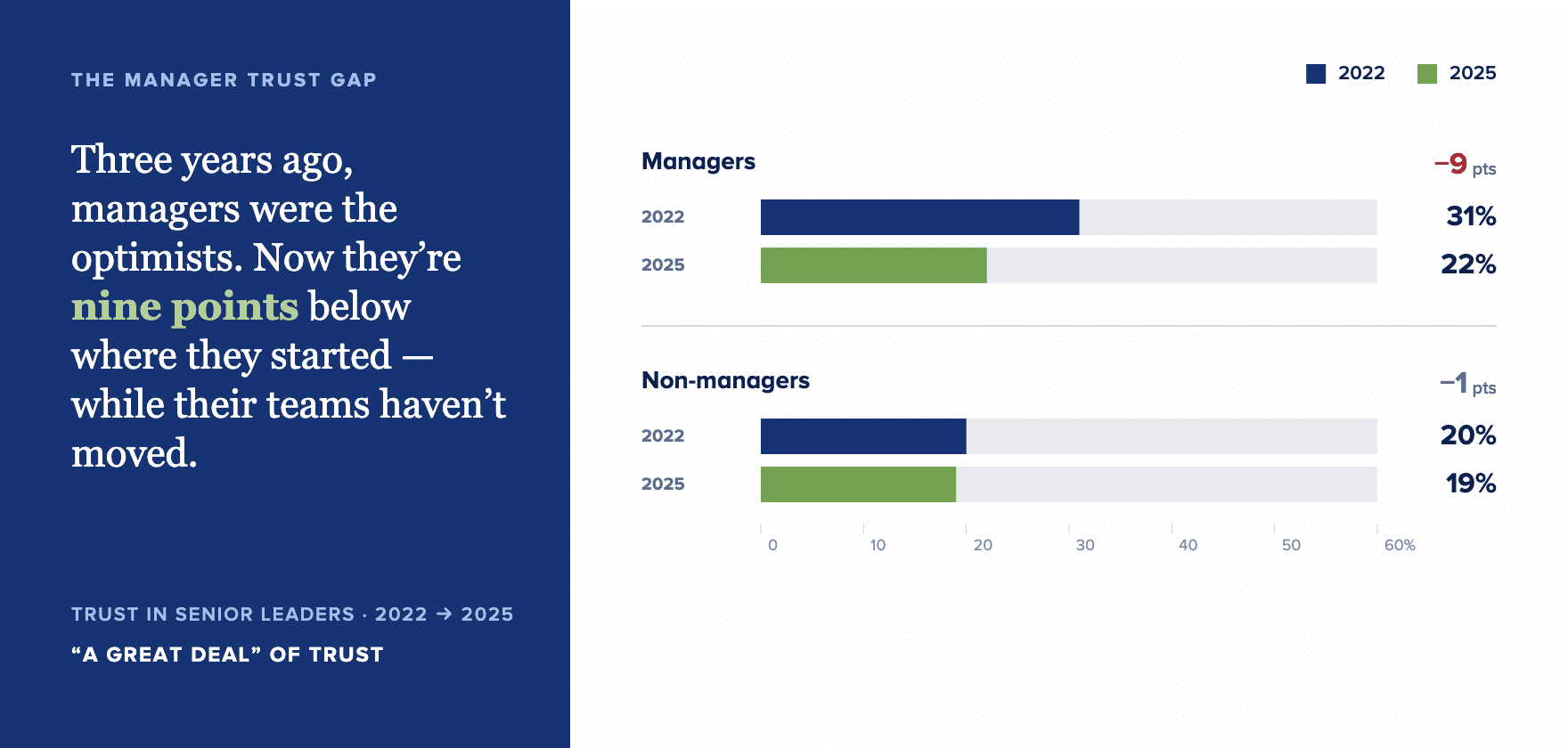
Global employee engagement sits at 20% in 2025, the lowest since 2020. But the real number is this one: manager engagement has dropped nine points since 2022, from 31% to 22%. In the same window, individual contributor engagement barely moved, from 20% to 19%. Managers used to report what Gallup called an “engagement premium.” They do not anymore. The gap has nearly closed, and not because individual contributors got fired up. It closed because managers ran out of room.
That shift is the story of this year’s report. And if you are leading a mid sized organization right now, it is the story you have to sit with before you do anything else in Q2.
Here are the three takeaways that matter.
Takeaway 1: The engagement decline is a manager decline
In 2024, engagement had already slipped two points globally and the warning signs were there. In 2025, it slipped another point. That alone is not a story. What is a story is where it came from.
Gallup’s 2026 data shows that managers are carrying almost all of the recent drop. Non manager engagement went from 20% in 2022 to 19% in 2025. Manager engagement went from 31% to 22% in the same period. Every five points of manager engagement Gallup loses is worth roughly 21 million workers disengaging at the team level, because managers set the weather for the people they lead.
The shift has a specific source: in 2025, South Asia saw an eight point drop in manager engagement. Gallup points to organizational flattening as the likely driver. Companies cut middle management roles, the remaining managers took on larger spans of control, and engagement collapsed.
That pattern is not limited to India’s IT sector. Every conversation I have had with a CEO of a 300 to 1,500 person company over the last year has touched the same thing. You pushed your managers to do more with less. You gave them bigger teams, more direct reports, fewer peers, and the same training budget you had five years ago. Some of them have been in that stretch position for two years. A few of them have been there for three.
They are not tired of work. They are tired of running a team without the tools, the peers, or the clarity to actually lead it.
“They are not tired of work. They are tired of running a team without the tools, the peers, or the clarity to actually lead it.”
Last year’s Gallup report cost the world an estimated $10 trillion in lost productivity, or 9% of global GDP. That number did not move by itself. It moved because the people in the middle who turn strategy into action have been asked to absorb more change than their capacity allows, and their own engagement has given out first.
That is leadership debt. It does not show up on the balance sheet. It shows up in attrition, in quiet quitting, in the second best hire you just had to make because the first best candidate turned you down.
Takeaway 2: AI is not saving you. Your managers are (or they are not)
The second shift in the 2026 report is the one every CEO I talk to is now wrestling with.
A recent MIT study found that despite roughly $40 billion in enterprise AI investment, 95% of organizations have seen zero measurable impact on profits. A National Bureau of Economic Research survey of nearly 6,000 global executives reported that 89% see no effect on labor productivity. In Gallup’s own data, only 12% of employees in organizations that have implemented AI strongly agree that AI has changed how work gets done.
So the tools are here. The money is spent. Nothing is moving.
The 2026 report names the reason directly, and this is the single most important paragraph in the whole document for any mid market leader. In organizations that have implemented AI, the strongest predictor of whether employees actually use it (other than basic technical integration) is whether their direct manager actively supports it. Employees whose manager champions the tool are 8.7 times more likely to say AI has changed how work gets done in their organization. They are 7.4 times more likely to say AI lets them do what they do best more often.
That is not a rounding error. That is the entire AI thesis living or dying inside the manager relationship.
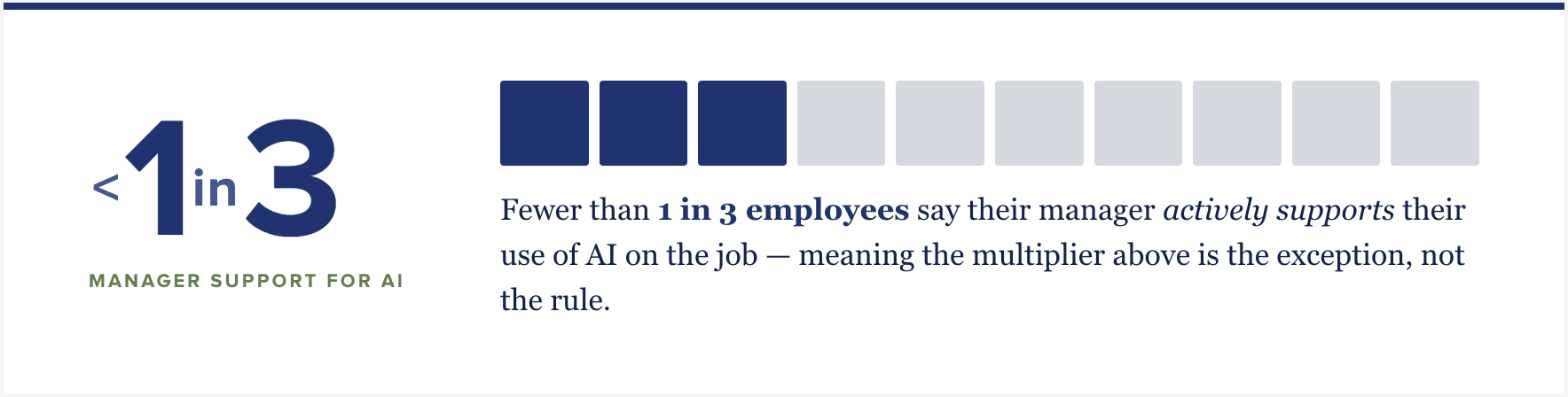
And Gallup found that fewer than a third of U.S. employees in AI adopting organizations say their manager actively supports their use of the technology. In Germany, the number is 21%. The tools are deployed. The managers have not been equipped to use them with their teams, or lead others through the change. So the tools sit there, and the investment resets.
This is not a technology problem. It is a management system problem, the same one we have had since Gallup started measuring this in 2009. AI did not create the gap. It made the gap louder and more expensive.
If you have invested in AI this year and your numbers are not moving, the first question is not whether you picked the right model. It is whether your managers have been trained, supported, and equipped to lead people through the change. If the answer is no (and for most mid market organizations I work with, the answer is no), you have a management system to build before the AI investment compounds.
Before you audit the AI rollout, know what your culture is signaling to your managers. The Leadership Culture Wayfinder surfaces that in three minutes. Take the Wayfinder →
Takeaway 3: 79% manager engagement is achievable. Four times the global average.
This is the takeaway that buried the lede in a lot of coverage. Gallup publishes a benchmark every year called “best practice organizations.” These are companies that have made employee engagement part of their long term strategy, not a slide in an HR deck.
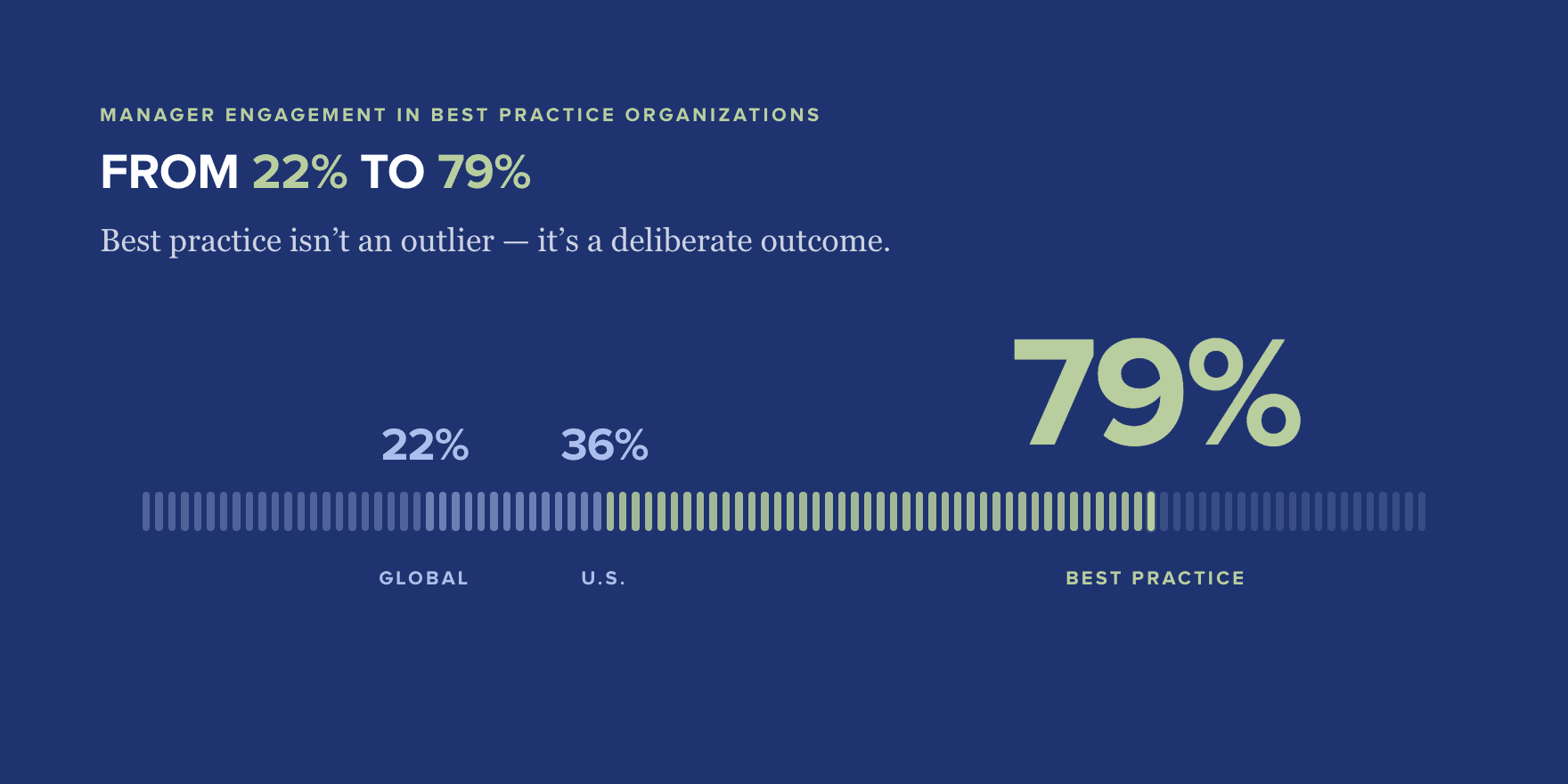
In 2025, manager engagement inside those organizations held at 79%. That is nearly four times the global average of 22%. It is double the U.S. average of 36%. Those organizations span every region and industry Gallup measures.
Which means two things.
First, a 22% manager engagement number is not destiny. It is the output of a set of choices, not a law of organizational life. Companies that choose to build leadership capacity deliberately are running at 79%. Companies that treat management as something people figure out on the way up are running at 22%. The gap between those two outcomes is not luck or industry. It is a system.
Second, the companies at 79% did not get there by running a better annual training event. They got there by building a system around their managers: cohort based development that creates peers, ongoing coaching that protects the capacity, cultural clarity that reinforces what managers are actually being asked to do. Engagement is a lagging indicator of whether that system exists.
I watched this play out recently with a 650 person manufacturer — a composite of three clients. They had flattened two layers of middle management over 18 months. They rolled out a generative AI platform at the start of 2025. By Q4, their engagement survey came back worse than the year before, and their best two plant managers had both given notice. Their VP of People described it to me as “the wheels coming off.”
A culture assessment surfaced what no one had named yet: managers felt unclear on what they were being asked to do, felt unsupported by their own leaders, and felt that every new rollout added to their plate without anything leaving it. The culture was signaling “absorb it” when it needed to signal “we have your back.”
They built a 100 day manager cohort. They stopped rolling out new initiatives for 90 days. They rebuilt one recurring meeting with their GMs from a status report into an actual working session on capacity and clarity. Engagement did not double overnight. But the two things that moved first were the two things that matter: the managers stopped quietly looking, and they started pulling their own teams along.
That is what the 79% organizations figured out. Management is a capacity problem before it is a talent problem. You do not fix it with a better LMS. You fix it with a system that treats your managers as the load bearing layer they actually are.
“Management is a capacity problem before it is a talent problem.”
What to do before the end of this quarter
Most CEOs reading a Gallup report feel the data, nod, and go back to their inbox. The one move I would push you to make this week is smaller than that and more useful.
Pull your managers out of one recurring meeting. Give them 90 minutes, a room (virtual is fine), and one real question on the table: “What is the biggest disconnect right now between what we are being asked to do and what we are actually equipped to do?”
Then listen.
You will not solve anything in 90 minutes. But you will find out whether you have a management system or a management assumption. And you will have the first real data point you have had all year on what is actually draining the layer that makes or breaks your 2026.
That is where the work starts.
That conversation will tell you a lot. The Leadership Culture Wayfinder tells you the rest. Three minutes to see what your culture is reinforcing and what it is quietly working against. Take the Wayfinder →
Frequently asked questions
What did Gallup’s 2026 Global Workplace Report find about employee engagement?
Global employee engagement fell to 20% in 2025, the lowest level since 2020 and the second consecutive year of decline. Gallup estimates the cost of low engagement at roughly $10 trillion, or 9% of global GDP. The largest regional drop was in South Asia (five points). No region saw engagement improve.
Why is manager engagement dropping faster than individual contributor engagement?
Manager engagement dropped nine points between 2022 and 2025 (from 31% to 22%), while non manager engagement dropped only one point (from 20% to 19%). Gallup points to organizational flattening, larger spans of control, and lack of support during technology rollouts (especially AI) as the primary drivers. Managers are being asked to absorb more change without a matching increase in capacity, tools, or peer support.
What does Gallup say about AI and employee engagement in 2026?
Despite roughly $40 billion in enterprise AI investment, 95% of organizations report no measurable impact on profits. Only 12% of employees in AI implementing organizations strongly agree that AI has changed how work gets done. The strongest predictor of AI adoption at the employee level (outside of technical integration) is whether the direct manager actively supports it. Employees whose managers champion AI are 8.7 times more likely to report the technology has changed their work.
What is the gap between average and best practice organizations on manager engagement?
In 2025, manager engagement inside Gallup’s best practice organizations held at 79%, versus 22% globally. That is nearly four times the global average. Gallup’s data shows these organizations span every region and industry, which means the gap is the result of deliberate leadership system choices rather than industry conditions or luck.
How should a mid sized company respond to the 2026 Gallup report?
The most useful first move is not a new training program. It is a direct conversation with your managers about where their capacity is actually breaking and what is draining them the most. From there, the pattern most best practice organizations follow is building a cohort based leadership development system, investing in manager support (coaching, peer accountability), and making sure culture is reinforcing rather than eroding the investment. The Leadership Culture Wayfinder gives you a starting point for understanding where your culture stands before you design the system.