
Executive Summary
You want more time, but everything still lands on your desk.
That is not a discipline problem on your team. It is a development gap: your people were promoted for performance and never built into leaders. Adding hours back to your week comes from multiplying leadership capacity, developing people who can think, decide, and act without you. This article shows the shift, with one tech CEO who reclaimed ten-plus hours a week.
The Case for Building a Leadership Bench
You want more time. But your team keeps bringing problems to your desk. Everyone still needs you. Hiring decisions, project approvals, client escalations all somehow land back on your desk. You are asking yourself, “Why can’t my team take initiative?”
Here is the truth: most teams want to step up. But they have not been developed to lead. You have not built your leadership bench yet.
Right now you are coaching performance, not developing leaders.
The Hidden Time Drain
You did not mean to create dependency. It happened naturally:
- On day one, you were the expert.
- You knew what “right” looked like.
- And it was often faster to do it yourself.
But now your business is bigger, and so is the cost of that habit. Without a leadership bench:
- You stay trapped in the weeds
- High-potential people wait instead of lead
- You cannot grow because you are the whole system. You have become the bottleneck.
Every hour you spend solving problems your team could solve is an hour you are not building the future.
Leaders Add Time by Multiplying Capacity
Owners often think the only way to gain time is to delegate. But delegation without development just shifts tasks.
Multiplying leadership capacity is the real solution: developing leaders who can think, decide, and act without you. You develop decision-makers, people who carry the weight instead of handing it back.
We help founders and executives move from heroic effort to sustainable empowerment.
Real-Life Story: The Tech CEO
A startup founder we worked with had built a 45-person SaaS company. He had talented directors, but they constantly came to him for budget approvals, product decisions, and personnel issues.
The founder worked 70-hour weeks, dreaming of a future that never came.
We walked the CEO through a People Development GPS to uncover the issue: every director had been promoted based on performance, but never developed as a leader. We launched the Next Level Leaders program, introduced CORE Plans, and mapped each director on the Delegation Cycle.
Six months later:
- Directors were running their own hiring and budgeting
- The CEO’s strategic planning time doubled
- Cross-functional collaboration increased, without him mediating
Three months in, he reclaimed 10-plus hours a week and started focusing on the work he enjoyed most.
Tools That Help: Multiplying Magic
The Multiplying Magic tool is a practical framework for intentional leadership development. It helps leaders move beyond doing tasks themselves to actively transferring skills and leadership behaviors to others.
The starting point is asking: what specific skill set or leadership behavior do I consistently deliver that brings value and needs to be multiplied?
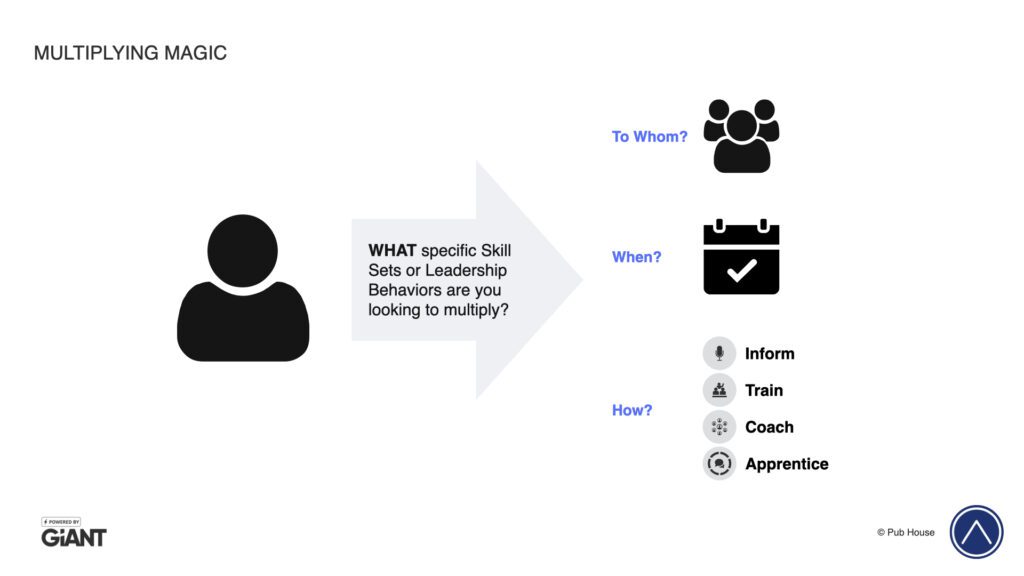
Rather than holding onto that “magic” as something only you can do, this tool calls you to give it away with clarity and purpose.
Once the “what” is defined, the next questions are:
- To Whom? Who on your team is ready or needs to grow in this area?
- When? When is the right time to begin the handoff?
This tool encourages leaders to think proactively about who needs development and not to wait until there is a crisis or a gap.
From there, the tool outlines four clear stages of transfer:
The four stages of transfer
-
1
Inform. Share the knowledge through information transfer.
-
2
Train. Provide structured practice.
-
3
Coach. Direct, one-to-one discussion to refine and personalize.
-
4
Apprentice. Ownership is transferred, and the new leader carries it forward with confidence.
These stages help ensure that development is not rushed or assumed. It is guided and intentional.
Multiplying Magic is about more than delegation. It is about building trust, expanding ownership, and creating a culture where leadership is not centralized but multiplied. Used consistently, it lets leaders replicate their best contributions in others, develop internal capacity, and build organizations that do not rely on a few but thrive through many.
This is how we create bigger futures: multiplying what is working, one leader at a time.
Three Practical Steps to Start This Month
- Audit Your Decisions: Track what decisions you are still owning. Identify which could be handled by others with the right coaching. Explore the 70:30 Task Plan from our ORG ID Playbook.
- Launch CORE Plans: Select two or three team members to pilot a CORE growth plan. Give them specific development goals, coaching rhythms, and feedback cycles.
More Leaders, More Time
What gives you time back is more leaders. That is what grows your business.
Key Takeaway
When you develop your bench, you buy back your time, build your team’s confidence, and create a culture that grows without breaking.
Let’s talk
Sometimes it starts with coffee.
Just a real conversation about where you are and where you want to go. We’ll listen first and bring you our best. We’d love to meet you.


